Good handwriting is far more than producing attractive letters. It reflects discipline, patience, concentration, and clarity of thought. More importantly, research increasingly suggests that handwriting contributes to brain development and learning in ways that typing alone cannot replicate.
As Mahatma Gandhi once said, “The future depends on what you do today.” Developing neat and legible handwriting during childhood is one such investment that yields lifelong benefits.
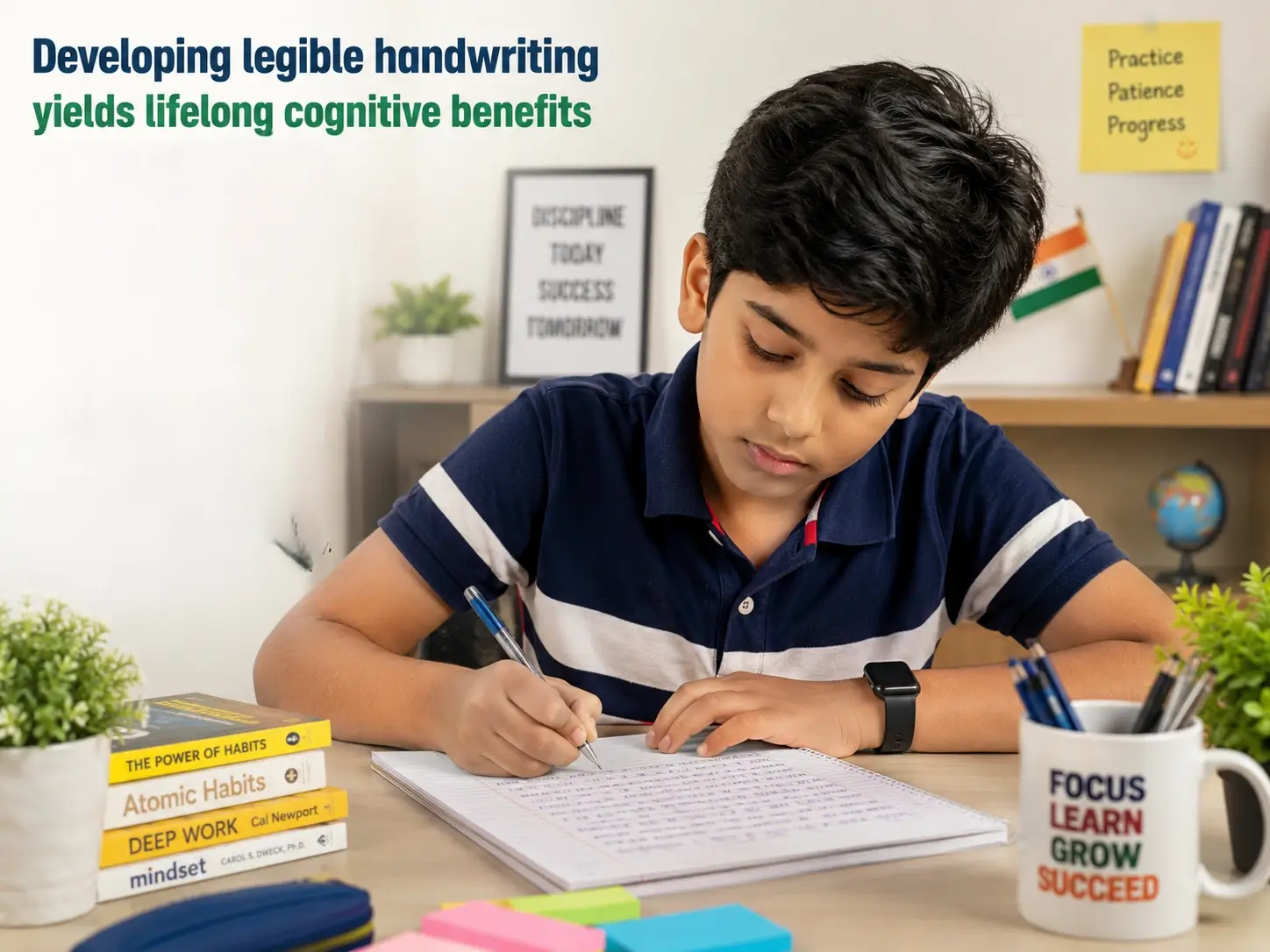
Handwriting Is Brain Writing
Writing by hand is not merely a mechanical activity. It engages multiple areas of the brain simultaneously. The eyes, fingers, muscles, and mind work together in harmony.
Maria Montessori believed, “The hand is the instrument of the mind.”
When children write by hand, they process information more deeply. They pay attention to spelling, sentence formation, and ideas. Studies have shown that handwriting strengthens memory and enhances understanding. Typing, although faster, often encourages passive copying. Handwriting, on the other hand, slows the mind enough to encourage reflection and comprehension.
Good Handwriting Builds Confidence
Every child wants to present his or her work with pride. A neat answer sheet or notebook often gives children a sense of accomplishment.
William James, the father of American psychology, observed, “Act as if what you do makes a difference. It does.”
Children who write clearly tend to receive positive feedback from teachers. This appreciation boosts confidence and motivates them to perform better. Poor handwriting, however, can become a source of frustration. Children may know the correct answers but lose marks because examiners struggle to read their responses. Confidence often begins with small successes, and handwriting can contribute significantly to that process.

Handwriting Improves Concentration
In today’s world, distractions are everywhere. Smartphones, notifications, and social media continuously compete for children’s attention. Writing by hand demands focus and patience.
Aristotle wisely stated, “We are what we repeatedly do. Excellence, then, is not an act but a habit.”
Regular handwriting practice develops:
Attention to detail
Fine motor skills
Patience
Discipline
Persistence
These qualities extend far beyond handwriting and influence many aspects of life.
Better Handwriting Often Leads to Better Academic Performance
Teachers frequently observe that children who maintain organized notebooks and write legibly tend to perform better academically. This does not mean that handwriting alone determines intelligence. Rather, good handwriting often reflects habits such as:
Carefulness
Taking time to ensure work is done right.
Time Management
Pacing thoughts with physical writing speed.
Presentation
Attention to visual layout and readability.
Regular Practice
Building systematic and organized thinking.
John Locke wrote, “Reading furnishes the mind only with materials of knowledge; it is thinking that makes what we read ours.”
Writing helps transform knowledge into understanding. Moreover, during examinations, clear handwriting allows evaluators to assess answers without difficulty, ensuring that children's efforts are properly recognized.
Handwriting Encourages Creativity
Journaling, storytelling, poetry, and sketching often begin with pen and paper. Albert Einstein famously remarked, “Imagination is more important than knowledge.”
Many writers, scientists, and thinkers preferred writing by hand because it allowed ideas to flow naturally. A notebook becomes a space where children can express dreams, emotions, and creativity without fear of judgment. Even in the digital age, handwritten diaries and notes retain a personal charm that computers cannot replace.

Handwriting Teaches Patience in an Instant World
Modern children are accustomed to speed. Messages are delivered instantly, and information is available within seconds. However, meaningful achievements often require patience and perseverance.
Confucius said: “It does not matter how slowly you go as long as you do not stop.”
Handwriting teaches children to slow down, pay attention, and value quality over speed. This lesson becomes invaluable later in life when facing challenges that cannot be solved instantly.
Beyond Academics: Life Skills Developed Through Handwriting
Good handwriting cultivates several life skills:
DisciplineConsistent practice builds routine and self-control.
OrganizationNeatly written notes encourage orderly thinking.
ResponsibilityChildren learn to take pride in their work.
MindfulnessWriting by hand promotes calmness and focus.
CommunicationClear writing ensures effective expression of ideas.
As Rabindranath Tagore beautifully wrote, “The highest education is that which does not merely give us information but makes our life in harmony with all existence.”
Handwriting contributes to this harmony by connecting thought, expression, and action.
Technology and Handwriting Can Coexist
Promoting handwriting does not mean rejecting technology. Children should certainly learn typing, coding, and digital literacy. These are essential skills for the future. Yet technology should complement, not replace, handwriting.
Steve Jobs once said: “Technology alone is not enough.”
The most effective education combines traditional skills with modern innovations. Children who possess both digital competence and strong handwriting enjoy the best of both worlds.

Parents and Schools Must Preserve This Skill
Many schools are reducing emphasis on handwriting, believing it to be outdated. However, abandoning handwriting altogether would be a mistake. Parents can encourage children by:
Materials
Providing quality writing materials.
Journals
Maintaining personal writing journals.
Letters
Encouraging letter writing to family.
Calligraphy
Practicing calligraphy for pure enjoyment.
Above all, parents should appreciate effort rather than demanding perfection. Teachers can focus on readability rather than demanding decorative writing styles. The goal should not be perfect handwriting but clear, comfortable, and confident writing.
Conclusion
In an era of artificial intelligence and digital communication, handwriting remains much more than an academic skill. It develops concentration, discipline, creativity, and confidence. It strengthens memory and enables children to express themselves clearly.
As philosopher Francis Bacon wisely observed, “Reading maketh a full man; conference a ready man; and writing an exact man.” Perhaps that is why handwriting still matters.